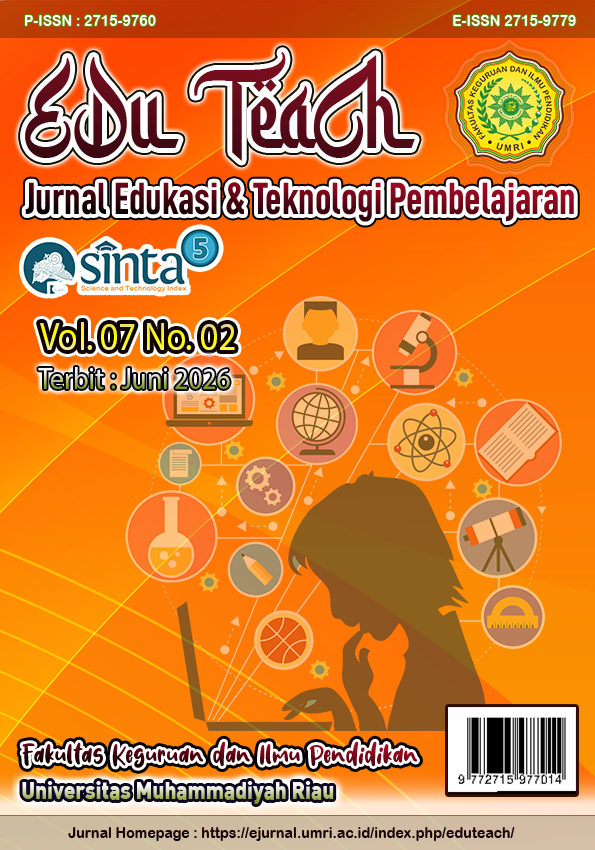
INOVASI ASESMEN DIGITAL MYPATRIOTIK: PENDEKATAN GAMIFIED CHUNKING UNTUK MENGURANGI OVERLOAD KOGNITIF DAN MENINGKATKAN SIKAP PATRIOTIK MAHASISWA
DOI:
 https://doi.org/10.37859/eduteach.v7i2.11688
Abstract
This study aims to validate the effectiveness of the digital assessment innovation, MyPatriotik, which integrates gamification and chunking principles, in simultaneously enhancing students' patriotic attitude and mitigating Extraneous Cognitive Load (ECL) in Civic Education (PPKn) learning. The research utilized a quantitative approach with a Pre-test Post-test Control Group Design, involving 80 PPKn students from UNIMED, split into an experimental group (using MyPatriotik) and a control group (conventional assessment). The findings revealed a statistically significant difference (sig. = 0.000) between the two groups. The experimental group showed a substantially higher increase in patriotic attitude and a sharp reduction in ECL compared to the control group. This success confirms the novelty of using gamification (realtime 1 vs 1 challenge) to boost affective engagement and chunking (in study materials) to optimize cognitive architecture by alleviating unnecessary cognitive burden. MyPatriotik offers a new pedagogical framework, transforming traditional assessment into an active catalyst for building national commitment and solving the issue of high ECL, aligning with the goal of quality education. Future research should focus on the long-term sustainability of these affective and cognitive gains.
Downloads
References
UNESCO. Rethinking education: towards a global common good? Paris: UNESCO Publishing; 2015. Available from: https://doi.org/10.54675/MDZL5552
Mudlofir A, Rusydiyah EF. Desain pembelajaran inovatif. Jakarta: Rajawali Pers; 2016.
Gultom S. Sosialisasi panduan penelitian dan PKM UNIMED 2025. Medan: UNIMED; 2024.
Wahab AA, Sapriya. Teori dan landasan pendidikan kewarganegaraan. Bandung: Alfabeta; 2011.
Skulmowski A, Xu KM. Understanding cognitive load in digital and online learning: A new perspective on extraneous cognitive load. Educational Psychology Review. 2021;34(1):176-196. Available from: https://doi.org/10.1007/s10648-021-09624-7
Sailer M, Homner L. The gamification of learning: a meta-analysis. Educational Psychology Review. 2020;32(1):77-112. Available from: https://doi.org/10.1007/s10648-019-09498-w
Ryan RM, Deci EL. Intrinsic and extrinsic motivation from a self-determination theory perspective: Definitions, theory, practices, and future directions. Contemporary Educational Psychology. 2020;61:101860. Available from: https://doi.org/10.1016/j.cedpsych.2020.101860
Thalmann M, Souza AS, Oberauer K. How does chunking help working memory? Journal of Experimental Psychology: Learning, Memory, and Cognition. 2019;45(1):37-55. Available from: https://doi.org/10.1037/xlm0000578
Winataputra US. Pendidikan kewarganegaraan (Refleksi historis-epistemologis dan rekonstruksi untuk masa depan). Tangerang Selatan: Universitas Terbuka; 2015.
Creswell J. Riset pendidikan (Perencanaan, pelaksanaan, dan evaluasi riset kualitatif dan kuantitatif). 5th ed. Yogyakarta: Pustaka Pelajar; 2015.
Yuliani SW. Penguatan sikap patriotisme remaja melalui pendidikan keluarga di Desa Wirogunan Kecamatan Kartasura Kabupaten Sukoharjo. Jurnal Pendidikan. 2019;28(2):183-194. Available from: https://doi.org/10.32585/jp.v28i2.346
Smiderle R, Marques B, Coelho APdM, Jaques. The impact of gamification on students’ learning, engagement and behavior based on their personality traits. Smart Learning Environments. 2020;7(3):1. Available from: https://doi.org/10.1186/s40561-019-0098-x
Lah CS, Hassan. Cognitive strategy in learning chemistry: How chunking and learning get together. The Malaysian Online Journal of Educational Science. 2014;2(1):9.
Siahaan RLM, Juli A, Najdah T. Perkembangan pendidikan berkualitas di Indonesia: Analisis SDGs 4. Indo-MathEdu Intellectuals Journal. 2023;14(2):974.
Downloads
Published
Issue
Section
License
Copyright (c) 2026 EduTeach : Jurnal Edukasi dan Teknologi Pembelajaran

This work is licensed under a Creative Commons Attribution-NonCommercial-ShareAlike 4.0 International License.


.png)