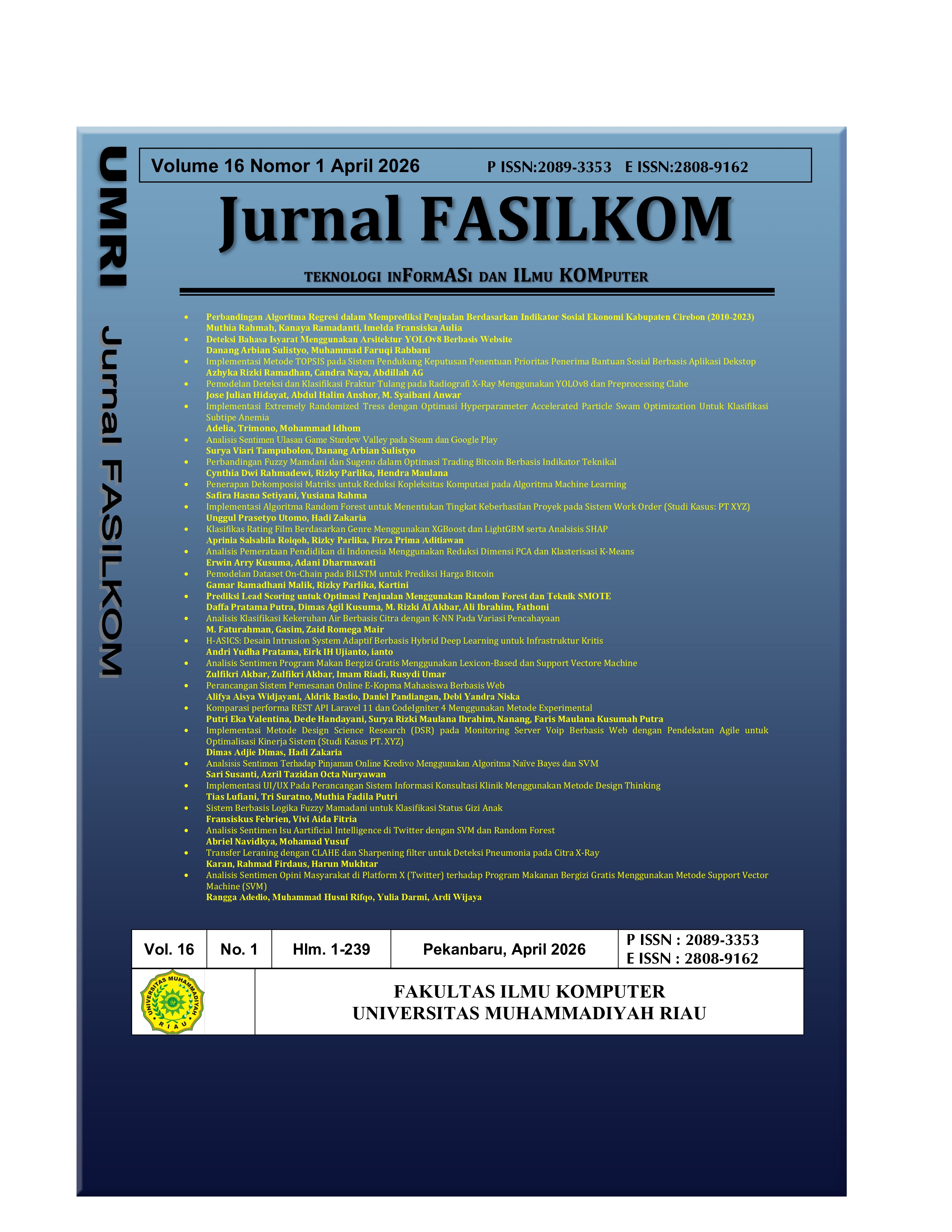
Perbandingan Algoritma Regresi dalam Memprediksi Penjualan Berdasarkan Indikator Sosial Ekonomi Kabupaten Cirebon (2010-2023)
DOI:
 https://doi.org/10.37859/jf.v16i1.9729
Abstract
A comparative study of four regression algorithms, namely Support Vector Regression (SVR), Gradient Boosting Regressor (GBR), Random Forest Regressor (RFR), and Extreme Gradient Boosting (XGBoost), was conducted to predict annual aggregate sales based on socioeconomic indicators in Cirebon Regency from 2010 to 2023. The study utilized secondary data obtained from the Central Bureau of Statistics (Badan Pusat Statistik) of Cirebon Regency. Five predictor variables were employed, including life expectancy, expected years of schooling, mean years of schooling, per capita expenditure, and the Human Development Index (HDI). Model performance was evaluated using Mean Absolute Error (MAE), Root Mean Square Error (RMSE), and the coefficient of determination (R-squared). The experimental results indicate that the GBR model achieved the best predictive performance, with the lowest error values (MAE = 127.98 and RMSE = 185.63) and the highest R² value (0.94), outperforming RFR, XGBoost, and SVR after parameter tuning. Feature importance analysis consistently identified life expectancy as the most influential variable across models. These findings demonstrate that ensemble-based regression methods, particularly boosting algorithms, are effective for modeling complex socioeconomic patterns and can support data-driven economic forecasting and regional policy planning
Downloads
References
N. D. Maulana, B. D. Setiawan, and C. Dewi, “Implementasi Metode Support Vector Regression (SVR) Dalam Peramalan Penjualan Roti (Studi Kasus: Harum Bakery),” J. Pengemb. Teknol. Inf. dan Ilmu Komput., vol. 3, no. 3, pp. 2986–2995, 2019, [Online]. Available: http://j-ptiik.ub.ac.id
Y. M. Nurak, S. Wahyu Iriananda, & F. Marisa, “Prediksi penjualan Warung Kopi OI menggunakan metode Random Forest dan XGBoost,” JATI (Jurnal Mahasiswa Teknik Informatika), vol. 9, no. 4, pp. 5796–5802, Aug. 2025, doi: 10.36040/jati.v9i4.13922.
Z. Aini, “Implementasi Random Forest Dan Gradient Boosting Pada Klasifikasi Indeks Pembangunan Manusia (IPM),” Skripsi, p. 90, 2023, [Online]. Available: https://repository.uinjkt.ac.id/dspace/handle/123456789/74286
A. Dahlan and R. Anggara, “Pengaruh Faktor Pendapatan, Konsumsi/Pengeluaran Rumah Tangga, Dan Tabungan Terhadap Tingkat Kesejahteraan Buruh Pada Industri Batu Alam Di Desa Bobos Dukupuntang Cirebon,” Syirkatuna J. Ekon. Islam, vol. 5, no. 1, pp. 1–14, 2017, [Online]. Available: https://ejournal.steialishlah.ac.id/index.php/syirkatuna/article/view/21
R. Hidayat et al., “Implementasi Algoritma Random Forest Regression Untuk Memprediksi Penjualan Produksi di Supermarket,” Simkom, vol. 10, no. 1, pp. 101–109, 2025, doi: 10.51717/simkom.v10i1.703.
N. A. A. Z. Tualeka AC, R. M. Atok, and A. U. Alfajriyah, “Perbandingan Metode Random Forest Regression (RFR) dan Support Vector Regression (SVR) dalam Memprediksi Risiko Kredit pada Bank XYZ,” J. Sains dan Seni ITS, vol. 13, no. 6, 2025, doi: 10.12962/j23373520.v13i6.150012.
S. V. Hutagalung, Y. Yennimar, E. R. Rumapea, M. J. G. Hia, T. Sembiring, and D. R. Manday, “Comparison of Support Vector Regression and Random Forest Regression Algorithms on Gold Price Predictions,” J. Sist. Inf. dan Ilmu Komput. Prima(JUSIKOM PRIMA), vol. 7, no. 1, pp. 255–262, 2023, doi: 10.34012/jurnalsisteminformasidanilmukomputer.v7i1.4125.
F. E. Penalun, A. Hermawan, and D. Avianto, “Perbandingan Random Forest Regression dan Support Vector Regression Pada Prediksi Laju Penguapan,” J. Fasilkom, vol. 13, no. 02, pp. 104–111, 2023, doi: 10.37859/jf.v13i02.4976.
F. Yulianto, W. F. Mahmudy, and A. A. Soebroto, “Comparison of Regression, Support Vector Regression (SVR), and SVR-Particle Swarm Optimization (PSO) for Rainfall Forecasting,” J. Inf. Technol. Comput. Sci., vol. 5, no. 3, pp. 235–247, 2020, doi: 10.25126/jitecs.20205374.
A. N. M. Pudjianto and E. Y. Hidayat, “Perbandingan Prediksi Depresi Mahasiswa dengan Linear Regression, Random Forest, dan Gradient Boosting,” SINTECH (Science Inf. Technol. J., vol. 7, no. 3, pp. 180–189, 2024, doi: 10.31598/sintechjournal.v7i3.1729.
I. Palupi, B. ari Wahyudi, N. AL Mamuda, and A. Shabrina, “Predicting Forest Fire Hotspots with Carbon Emission Insights Using Random Forest and Gradient Boosting Regression,” Int. J. Inf. Commun. Technol., vol. 9, no. 2, pp. 137–149, 2023, doi: 10.21108/ijoict.v9i2.865.
K. C. Liao, H. Y. Wu, H. T. Wen, J. T. Sung, M. Hidayat, and W. W. J. Wang, “Compressor performance prediction: gradient boosting regression model and sensitivity analysis,” Indones. J. Electr. Eng. Comput. Sci., vol. 37, no. 2, pp. 1201–1208, 2025, doi: 10.11591/ijeecs.v37.i2.pp1201-1208.
A. N. Rachmi, “Implementasi Metode Random Forest Dan Xgboost Pada Klasifikasi Customer Churn,” Univ. Islam Indones., vol., no., pp. 1–101, 2020.
A. Syahreza, N. K. Ningrum, and M. A. Syahrazy, “Perbandingan Kinerja Model Prediksi Cuaca: Random Forest, Support Vector Regression, dan XGBoost,” Edumatic J. Pendidik. Inform., vol. 8, no. 2, pp. 526–534, 2024, doi: 10.29408/edumatic.v8i2.27640.
I. Maulita and A. M. Wahid, “Prediksi Magnitudo Gempa Menggunakan Random Forest, Support Vector Regression, XGBoost, LightGBM, dan Multi-Layer Perceptron Berdasarkan Data Kedalaman dan Geolokasi,” J. Pendidik. dan Teknol. Indones., vol. 4, no. 5, pp. 221–232, 2024, doi: 10.52436/1.jpti.470.
R. Hidayat, D. Mahdiana, and A. Fergina, “Comparative Analysis of Logistic Regression, SVM, Xgboost, and Random Forest Algorithms for Diabetes Classification,” J. Teknol. Sist. Inf. dan Apl., vol. 7, no. 1, pp. 281–291, 2024, doi: 10.32493/jtsi.v7i1.38258.
E. Banjarnahor, R. Belferik, W. Cendana, Y. Adi, and S. Abraham, “Analisis Implementasi Support Vector Machine dan Random Forest untuk Prediksi Kategori Indeks Kualitas Udara Jakarta under a Creative Commons Attribution-NonCommercial ShareAlike 4.0 International (CC BY-NC-SA 4.0),” vol. 10, no. 1, pp. 2541–1179, 2025, doi: 10.24252/instek.v10i1.56477.
S. Papadogiannaki, S. Kontos, D. Parliari, and D. Melas, “Machine Learning Regression to Predict Pollen Concentrations of Oleaceae and Quercus Taxa in Thessaloniki, Greece,” p. 2, 2023, doi: 10.3390/environsciproc2023026002.
Downloads
Published
Issue
Section
License
Copyright (c) 2026 Muthia Rahmah, Kanaya Ramadanti, Imelda Fransiska Aulia

This work is licensed under a Creative Commons Attribution-ShareAlike 4.0 International License.
Copyright Notice
An author who publishes in the Jurnal FASILKOM (teknologi inFormASi dan ILmu KOMputer) agrees to the following terms:
- Author retains the copyright and grants the journal the right of first publication of the work simultaneously licensed under the Creative Commons Attribution-ShareAlike 4.0 License that allows others to share the work with an acknowledgement of the work's authorship and initial publication in this journal
- Author is able to enter into separate, additional contractual arrangements for the non-exclusive distribution of the journal's published version of the work (e.g., post it to an institutional repository or publish it in a book) with the acknowledgement of its initial publication in this journal.
- Author is permitted and encouraged to post his/her work online (e.g., in institutional repositories or on their website) prior to and during the submission process, as it can lead to productive exchanges, as well as earlier and greater citation of the published work (See The Effect of Open Access).
Read more about the Creative Commons Attribution-ShareAlike 4.0 Licence here: https://creativecommons.org/licenses/by-sa/4.0/.