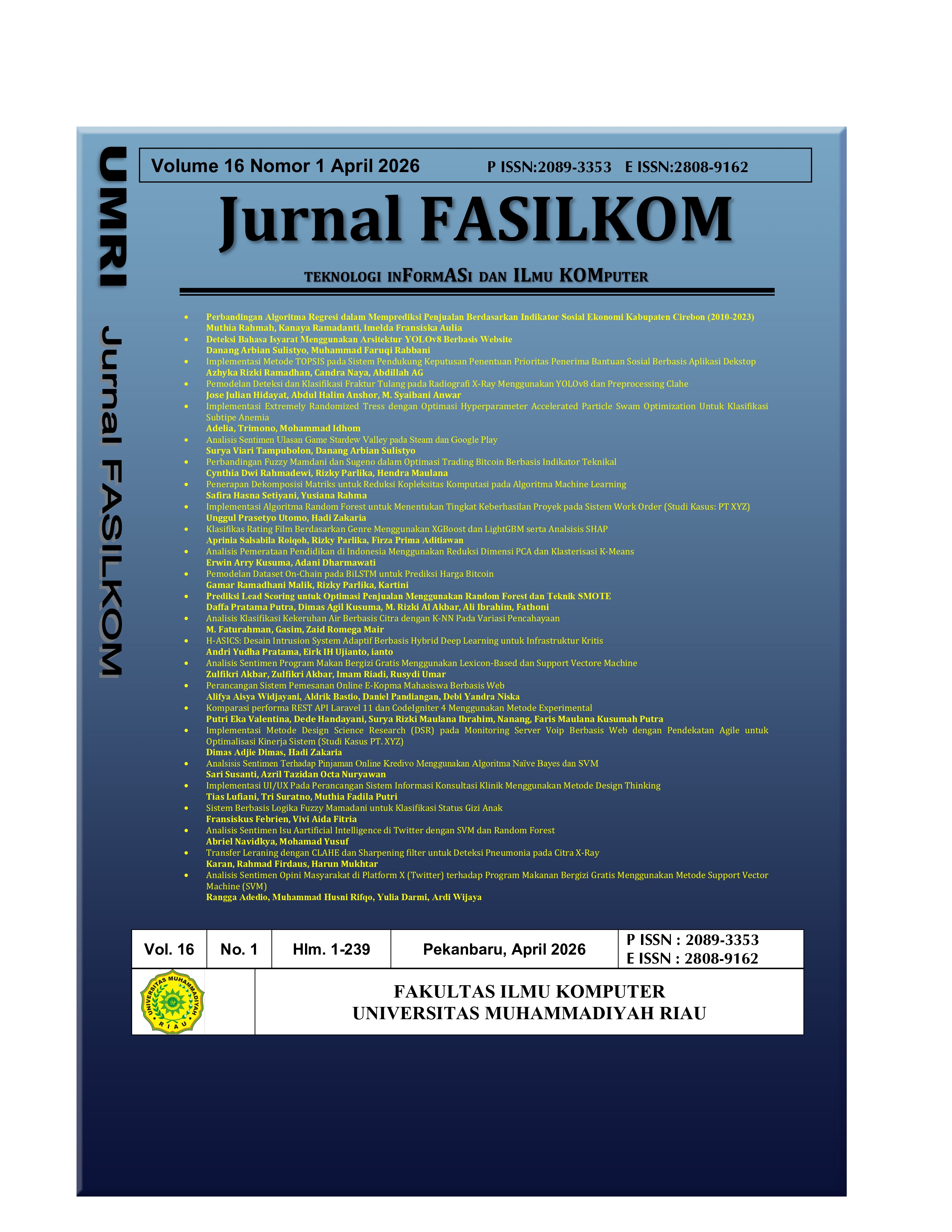
Perancangan Sistem Pemesanan Online E-Kopma Mahasiswa Berbasis Web
DOI:
 https://doi.org/10.37859/jf.v16i1.11338
Abstract
The development of information technology is now increasingly driving digital transformation in various fields, except for student cooperatives. Currently, KOPMA FMIPA Universitas Negeri Medan still relies on traditional ordering methods that often result in long queues, slow service, plus suboptimal data management. Therefore, this research focuses on creating and developing an online ordering system via the web (E-KOPMA) to overcome these problems. The way it works uses the Waterfall model to create the software, starting from analyzing what is needed, system design, coding, to testing. The system is built with PHP and MySQL, plus the illustration uses UML. For testing, Black Box Testing is used so that all features work as expected. From the results, this system really helps ease the process of ordering goods, reduce the number of queues, and make service smoother. Key features such as login, managing product stock, shopping carts, and payment processes, all work well and pass the test. So, E-KOPMA can be the right answer to improve service quality plus manage buying and selling data faster and more precisely
Downloads
References
C. Pratama, F. Ramadhan, G. A. Satria, and A. Setiawan, “Penerapan Empirical-Bayes pada Sistem Peringkat Produk E-Commerce,” vol. 15, no. 3, pp. 572–579, 2025.
S. J. Sains, P. H. P. Dan, M. Pada, K. Dinas, P. Dan, and O. K. Medan, “SITek: Jurnal Sains, Informatika, dan Tekonologi E-ISSN: 2964-6901,” 2022.
R. Amelia et al., “Berbasis Web Dengan Pendekatan Rekayasa Perangkat Lunak,” vol. 9, no. 4, pp. 6126–6130, 2025.
L. J. Pangaribuan, S. Sinaga, D. L. Siagian, and C. H. P. Panjaitan, “Implementasi Metode Waterfall dalam Rekayasa Perangkat Lunak Stok Barang Berbasis Web,” vol. 13, no. 01, pp. 53–61, 2025.
A. Fitri et al., “Perancangan Aplikasi Sistem Kasir Berbasis Web Menggunakan Metode Waterfall Pada Seventeen Petshop,” vol. 8, no. 4, pp. 6163–6170, 2024.
I. P. Sari, A. Jannah, A. M. Meuraxa, A. Syahfitri, and R. Omar, “Perancangan Sistem Informasi Penginputan Database Mahasiswa Berbasis Web,” 2022.
A. T. Hidayati, A. E. Widyantoro, and H. J. Ramadhani, “Perancangan Sistem Informasi Wirausaha Mahasiswa ( Siwirma ) Berbasis Web dengan Unified Modelling Languange ( UML ) Institut Teknologi dan Bisnis Semarang untuk memodelkan sistem [ 6 ]. Definisi lainnya , UML merupakan kumpulan diagram yang UML mempunyai,” vol. 2, no. 4, 2023.
A. Voutama, S. Informasi, F. I. Komputer, U. S. Karawang, and S. Informasi, “Perancangan Aplikasi Penjualan Fashion Dan Aksesoris Berbasis Web Pada Toko Fitrin,” vol. 7, no. 2, pp. 1364–1371, 2023.
C. A. Binangkit, A. Voutama, N. Heryana, F. I. Komputer, U. S. Karawang, and A. Musik, “Pemanfaatan Uml ( Unified Modeling Language ) Dalam Perencanaan Sistem Pengelolaan Sewa Alat Musik Berbasis,” vol. 7, no. 2, pp. 1429–1436, 2023.
J. J. J. Manajemen, I. Komputer, R. Efendi, J. Celvin, and S. Purba, “Perancangan Sistem Informasi Manajemen Toko Kelontong Berbasis WEB ( Studi Kasus Toko Semoga Jaya ),” vol. 1, no. 1, 2024.
Downloads
Published
Issue
Section
License
Copyright (c) 2026 Alifya Aisya Widjayani, Aldrik Bastio, Daniel Pandiangan, Debi Yandra Niska

This work is licensed under a Creative Commons Attribution-ShareAlike 4.0 International License.
Copyright Notice
An author who publishes in the Jurnal FASILKOM (teknologi inFormASi dan ILmu KOMputer) agrees to the following terms:
- Author retains the copyright and grants the journal the right of first publication of the work simultaneously licensed under the Creative Commons Attribution-ShareAlike 4.0 License that allows others to share the work with an acknowledgement of the work's authorship and initial publication in this journal
- Author is able to enter into separate, additional contractual arrangements for the non-exclusive distribution of the journal's published version of the work (e.g., post it to an institutional repository or publish it in a book) with the acknowledgement of its initial publication in this journal.
- Author is permitted and encouraged to post his/her work online (e.g., in institutional repositories or on their website) prior to and during the submission process, as it can lead to productive exchanges, as well as earlier and greater citation of the published work (See The Effect of Open Access).
Read more about the Creative Commons Attribution-ShareAlike 4.0 Licence here: https://creativecommons.org/licenses/by-sa/4.0/.