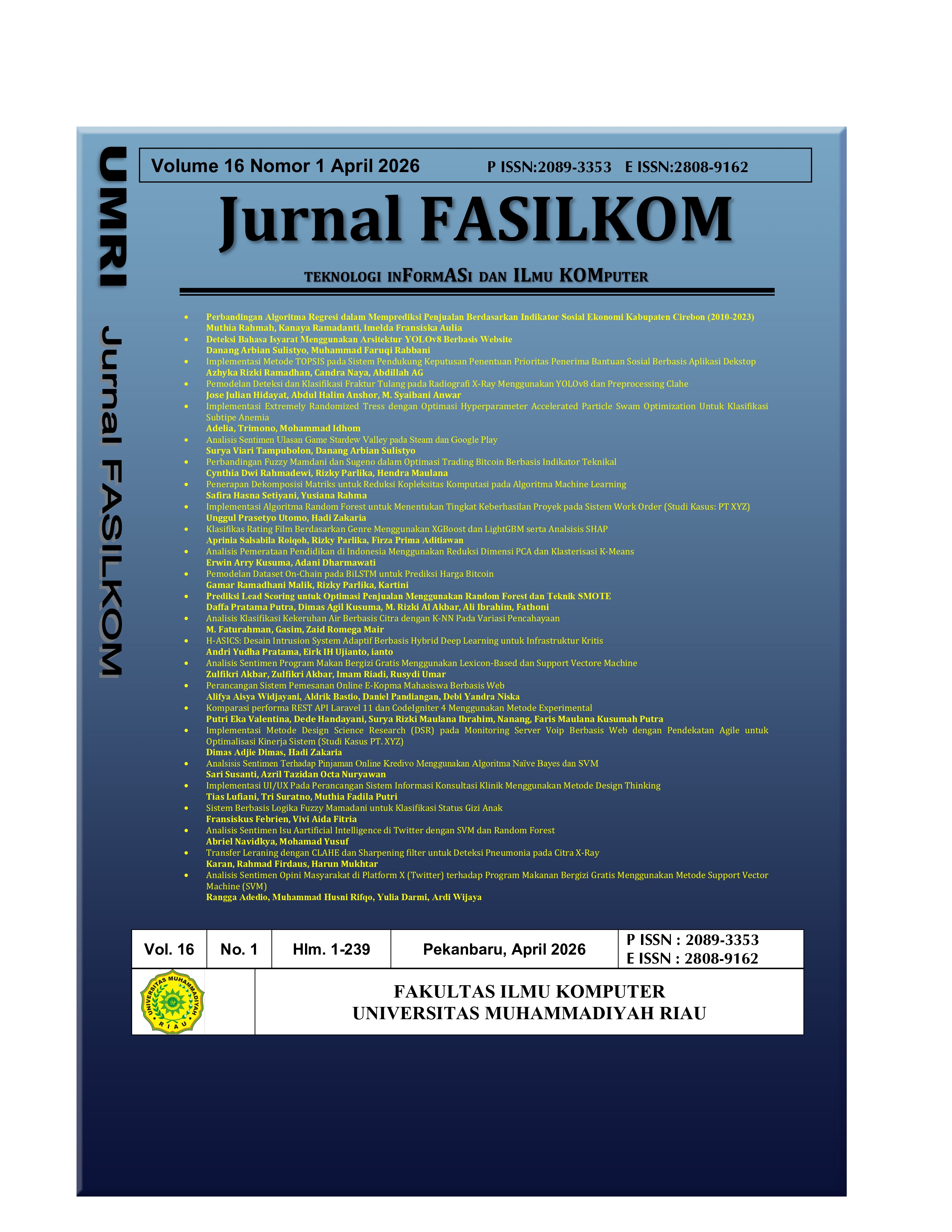
Perbandingan Fuzzy Mamdani dan Sugeno dalam Optimasi Trading Bitcoin Berbasis Indikator Teknikal
DOI:
 https://doi.org/10.37859/jf.v16i1.11235
Abstract
This study compares Mamdani and Sugeno fuzzy inference systems for Bitcoin trading using historical BTC/USDT data. In highly volatile and non-linear cryptocurrency markets, especially during bear markets, conventional methods struggle to interpret ambiguous signals, making fuzzy logic suitable for adaptive decision-making. The dataset was collected from the Binance API for the period 20 November 2021 to 31 December 2022 and consists of 9,746 candlestick records. This period corresponds to a bear market phase, characterized by a significant downward trend in Bitcoin prices, which provides a challenging environment for evaluating trading strategies. Four technical indicators, Bollinger Bands, RSI, ADX, and PSAR, were used as input variables. The data were split into 70% training and 30% testing using a time-based approach. Performance evaluation was conducted through long-only backtesting using Total Profit, Win Rate, Maximum Drawdown, Sharpe Ratio, and Sortino Ratio. The results show that Mamdani achieved better profitability than Sugeno, with total profit of -34.17% on training data and -2.45% on testing data, while Sugeno produced -53.91% and -3.04%, respectively. Although both methods resulted in negative returns due to the bearish market conditions, their performance was better than the buy-and-hold strategy, which recorded losses of -65.78% on training data and -17.49% on testing data. This indicates that both fuzzy approaches were effective in reducing losses and improving risk management under extreme market conditions. However, Sugeno showed better risk control on testing data with a lower maximum drawdown of 18.72% compared to 25.01% for Mamdani. Overall, Mamdani is more suitable for return-oriented strategies, while Sugeno is more appropriate for risk management under bearish conditions.
Downloads
References
G. S. Atsalakis, I. G. Atsalaki, F. Pasiouras, dan C. Zopounidis, “Bitcoin price forecasting with neuro-fuzzy techniques,” Eur. J. Oper. Res., vol. 276, no. 2, hal. 770–780, 2019, doi: 10.1016/j.ejor.2019.01.040.
F. A. Sihombing, “Kajian Fuzzy Metode Mamdani dan Fuzzy Metode Sugeno serta Implementasinya,” Innov. J. Soc. Sci. Res., vol. 4, no. 4, hal. 4940–4955, 2024.
A. Gezer, “Chaos in Bitcoin Cryptocurrency Metrics: Analysis and Forecasts,” Arab. J. Sci. Eng., vol. 50, no. 8, hal. 5869–5884, 2025, doi: 10.1007/s13369-024-09357-z.
D. Febri Kuncoro dan Purwono, “Penerapan Logika Fuzzy dalam Penanganan Penyakit Diabetes: Sistematik Literatur Review,” J. Kolaborasi Ris. Sarj., vol. 14, hal. 36, 2024, [Daring]. Tersedia pada: https://ejournal.uhb.ac.id/index.php/korisa
A. Ikhwan, “Penerapan Fuzzy Mamdani Untuk Sistem Pendukung Keputusan Pemilihan Laptop,” J. Fasilkom, vol. 9, no. 2, hal. 476–483, 2019, doi: 10.37859/jf.v9i2.1407.
T. M. Tupinambás, R. A. Leão, dan A. P. Lemos, “Cryptocurrencies transactions advisor using a genetic mamdani-type fuzzy rules based system,” IEEE Int. Conf. Fuzzy Syst., vol. 2018-July, 2018, doi: 10.1109/FUZZ-IEEE.2018.8491619.
C. Trading, “Backtesting Strategies for Backtesting Strategies for,” 2025.
A. Ikhwan, “Sistem Pendukung Keputusan Untuk Penentuan Penerima Beras Raskin Dengan Metode Fuzzy Mamdani,” J. Fasilkom, vol. 9, no. 2, hal. 457–463, 2019, doi: 10.37859/jf.v9i2.1406.
E. Nurhalizah Nst, L. Efriyanti, S. Zakir, dan Supriadi, “Sistem Pendukung Keputusan Rekomendasi Pemilihan Topik Judul Skripsi Menggunakan Metode Logika Fuzzy,” J. Fasilkom, vol. 13, no. 3, hal. 464–470, 2023, doi: 10.37859/jf.v13i3.6101.
J. Pascual-Fontanilles, A. Valls, A. Moreno, dan P. Romero-Aroca, “Continuous Dynamic Update of Fuzzy Random Forests,” Int. J. Comput. Intell. Syst., vol. 15, no. 1, 2022, doi: 10.1007/s44196-022-00134-0.
A. Hudon, “A hybrid fuzzy logic–Random Forest model to predict psychiatric treatment order outcomes: an interpretable tool for legal decision support,” Front. Artif. Intell., vol. 8, no. June, hal. 1–8, 2025, doi: 10.3389/frai.2025.1606250.
A. Suprasetyo, A. D. Kalifa, dan S. Diwandari, “Penyiraman Otomatis dan System Monitoring Bibit Kelapa Sawit Meng[1] A. Suprasetyo, A. D. Kalifa, and S. Diwandari, ‘Penyiraman Otomatis dan System Monitoring Bibit Kelapa Sawit Menggunakan Metode Fuzzy Sugeno,’ J. Fasilkom, vol. 13, no. 3, pp. 431–437, 2,” J. Fasilkom, vol. 13, no. 3, hal. 431–437, 2023.
N. Berutu dan Sriani, “Deteksi Tingkat Depresi Kerja Pada Guru Sekolah Dasar Menggunakan Metode Fuzzy Mamdani,” J. Fasilkom, vol. 14, no. 2, hal. 541–548, 2024, doi: 10.37859/jf.v14i2.7739.
R. Parlika, Mustafid, dan B. Rahmat, “Minimum, Maximum, and Average Implementation of Patterned Datasets in Mapping Cryptocurrency Fluctuation Patterns,” Int. J. Informatics Vis., vol. 8, no. 1, hal. 378–386, 2024, doi: 10.62527/joiv.8.1.1543.
T. Conlon dan R. McGee, “Safe haven or risky hazard? Bitcoin during the Covid-19 bear market,” Financ. Res. Lett., vol. 35, no. April, hal. 101607, 2020, doi: 10.1016/j.frl.2020.101607.
A. Munazilin, M. A. Wibowo, dan R. Parlika, “Bitcoin Price Prediction : A Systematic Literature Review and Bibliometric Analysis,” 2025 9th Int. Conf. Inf. Technol. Inf. Syst. Electr. Eng., hal. 277–282, 2025, doi: 10.1109/ICITISEE68184.2025.11355086.
M. Rosdiana, “Analisis Hasil Perbandingan Fuzzy Inference System Metode Mamdani Dan Sugeno Dalam Estimasi Produksi Telur,” Sci. Sacra J. Sains, Teknol. dan Masy., vol. 3, no. 4, hal. 63–77, 2023, [Daring]. Tersedia pada: http://pijarpemikiran.com/index.php/Scientia
I. T. Julianto dan M. R. Dzulkhomzah, “Sistem Pendukung Keputusan Pemilihan Supplier Bahan Baku Pengadaan Material Golf Bag Custom Berbasis Simple Additive Weighting,” J. Algoritm., vol. 22, no. 1, hal. 893–904, 2025, doi: 10.33364/algoritma/v.22-1.1731.
N. F. I. P. Irwansyah, A. Jaya, dan N. Nasrullah, “Effectiveness of RSI and Bollinger Bands in Identifying Buy and Sell Signals,” Wiga J. Penelit. Ilmu Ekon., vol. 15, no. 1, hal. 60–70, 2025, doi: 10.30741/wiga.v15i1.1443.
Downloads
Published
Issue
Section
License
Copyright (c) 2026 Cynthia Dwi Rahmadewi, Rizky Parlika, Hendra Maulana

This work is licensed under a Creative Commons Attribution-ShareAlike 4.0 International License.
Copyright Notice
An author who publishes in the Jurnal FASILKOM (teknologi inFormASi dan ILmu KOMputer) agrees to the following terms:
- Author retains the copyright and grants the journal the right of first publication of the work simultaneously licensed under the Creative Commons Attribution-ShareAlike 4.0 License that allows others to share the work with an acknowledgement of the work's authorship and initial publication in this journal
- Author is able to enter into separate, additional contractual arrangements for the non-exclusive distribution of the journal's published version of the work (e.g., post it to an institutional repository or publish it in a book) with the acknowledgement of its initial publication in this journal.
- Author is permitted and encouraged to post his/her work online (e.g., in institutional repositories or on their website) prior to and during the submission process, as it can lead to productive exchanges, as well as earlier and greater citation of the published work (See The Effect of Open Access).
Read more about the Creative Commons Attribution-ShareAlike 4.0 Licence here: https://creativecommons.org/licenses/by-sa/4.0/.