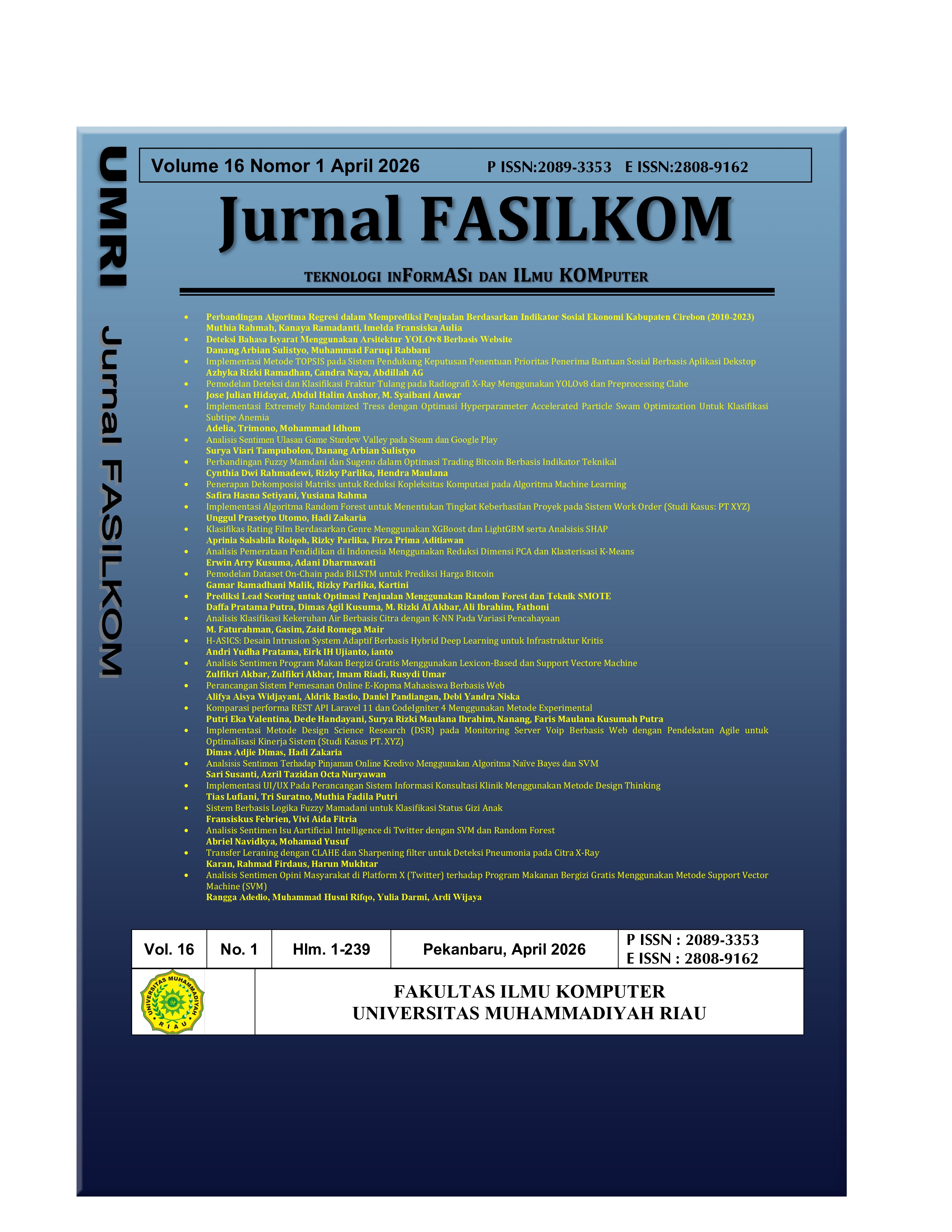
Sistem Berbasis Logika Fuzzy Mamdani Untuk Klasifikasi Status Gizi Anak
DOI:
 https://doi.org/10.37859/jf.v16i1.10933
Abstract
Malnutrition among children under five remains a critical public health challenge, particularly in primary healthcare settings where assessment is often conducted manually and relies on a single anthropometric index. This study proposes a Mamdani fuzzy logic-based classification system designed to assess children’s nutritional status at Puskesmas Nanu by simultaneously incorporating four anthropometric parameters: age (months), height, weight, and mid-upper arm circumference (MUAC). Unlike previous studies that typically employ one or two indicators, this system constructs a comprehensive inference framework consisting of 135 IF-THEN rules derived from all possible combinations of fuzzy input sets. Triangular and trapezoidal membership functions are applied to each variable to capture the gradual transitions inherent in children’s growth conditions. The inference engine employs the MIN operator for rule activation and MAX for aggregation, while centroid defuzzification converts the aggregated fuzzy output into a deterministic crisp value. The system was evaluated against 20 anthropometric records from the facility and compared with the conventional Z-score method used by healthcare workers. Results show that 15 out of 20 cases were classified consistently, yielding an accuracy rate of 75%. In a representative case of a 59-month-old child, the system produced a crisp output of −0.25, corresponding to the normal nutritional status category. These findings demonstrate that the proposed system offers a more holistic and objective approach to nutritional assessment. Limitations include the relatively small sample size and membership function domains derived from local data rather than standardized WHO references. Future work should focus on expanding the dataset, aligning parameters with national anthropometric standards, and implementing the system as a web-based or mobile application integrated into primary healthcare information systems.
Downloads
References
P. Kanah Arieska, N. Herdiani, P. Studi, K. Masyarakat, and F. Kesehatan, “HUBUNGAN PENGETAHUAN DAN POLA KONSUMSI DENGAN STATUS GIZI PADA MAHASISWA KESEHATAN,” Sep. 2020. doi: 10.33086/mtphj.v4i2.1199.
Ninda Rizki Aulia, “Peran Pengetahuan Gizi Terhadap Asupan Energi, Status Gizi Dan Sikap Tentang Gizi Remaja,” Jurnal Ilmiah Gizi dan Kesehatan (JIGK), vol. 02, pp. 31–35, 2021, doi: 10.46772/jigk.v2i02.454.
D. Lukitasari, O. Pratama, and I. Nurhidayah, “Hubungan Peran Ibu Dengan Status Gizi Balita Di Kelurahan Padasuka,” HealthCaring: Jurnal Ilmiah Kesehatan, vol. 4, pp. 14–24, Jan. 2025, doi: 10.47709/healthcaring.v4i1.6119.
E. Lusiana, R. Pratiwi, P. S. Studi, K. STIKES Panakkukang, P. D. Studi, and P. Studi Profesi Ners STIKES Panakkukang, “Deteksi Dini Stunting Melalui Pengukuran Antropometri Pada Anak Usia Balita.” doi: https://doi.org/10.36908/akm.v4i1.862.
A. U. Hasanah et al., “Edukasi dan Evaluasi Kondisi Gizi Remaja di Tingkat SMA Negeri 11 Samarinda,” Bima Abdi: Jurnal Pengabdian Masyarakat, vol. 5, no. 2, pp. 402–411, May 2025, doi: 10.53299/bajpm.v5i2.1750.
R. Yuningsih and R. Kurniasari, “PENGARUH EDUKASI GIZI MELALUI MEDIA BERGAMBAR DAN PERMAINAN TERHADAP PENGETAHUAN GIZI SEIMBANG PADA ANAK SEKOLAH DASAR (SUATU PENDEKATAN STUDI LITERATURE REVIEW),” 2022. doi: 10.32832/hearty.v10i1.4786.
Y. Petrika et al., “BALITA SECARA MANDIRI OLEH ORANG TUA Stunting Education Using A Focus Group Discussion (FGD) Approach And Training in Independent Monitoring of Toddler’s Growth by Parents,” JURNAL PENGABDIAN MASYARAKAT KESEHATAN INDONESIA, vol. 2, no. 2, pp. 257–263, 2023, doi: 10.34011/jpmki.v1i2.1775.
S. Permana Ratumanan and A. Feinisa Khairani, “SUPLEMEN Volume 15, Suplemen, 2023 https://myjurnal.poltekkes-kdi.ac.id/index.php/hijp e704 HIJP : HEALTH INFORMATION JURNAL PENELITIAN Metode Antropometri Untuk Menilai Status Gizi : Sebuah Studi Literatur,” 2023. [Online]. Available: https://myjurnal.poltekkes-kdi.ac.id/index.php/hijp
P. Faster, E. Adipraja, D. A. Sulistyo, and I. Wahyuni, “PEMODELAN FUZZY INFERENCE SYSTEM TSUKAMOTO UNTUK PREDIKSI KEJADIAN BANJIR DI KOTA MALANG,” vol. 7, no. 1, pp. 189–196, 2020, doi: 10.25126/jtiik.202071898.
F. R. Safal, “Prediksi Status Gizi Balita Menggunakan Logika Fuzzy Metode Sugeno Berdasarkan Pengukuran Antropometri,” JAMASTIKA (Jurnal Mahasiswa Teknik Informatika), vol. 3, pp. 28–33, Apr. 2024, doi: 10.35473/jamastika.v3i1.2459.
Yan Arie Strada Tuhehay, Intan Nur Farida, and Made Ayu Dusea Widyadara, “Penentuan Gizi Balita Kelurahan Bangsal Dengan Fuzzy Mamdani Berbasis Website,” Prosiding SEMNAS INOTEK, vol. 9, pp. 1141–1150, 2025, doi: 10.29407/n24nan53.
A. Fariza, R. Asmara, and G. N. Istiqomah, “Visualisasi Spasial Temporal Tingkat Risiko Stunting di Jawa Timur Menggunakan Metode Fuzzy Spatial Temporal Visualization of Stunting Risk Level in East Java Using Fuzzy Method,” Jurnal Teknologi dan Informasi, pp. 83–95, 2023, doi: 10.34010/jati.v13i1.
P. S. Indriani, “Asupan Nutrisi, Indeks Masa Tubuh (IMT) dan Lingkar Lengan Atas (LILA) Ibu Menyusui berhubungan dengan Status Gizi dan Pemberian ASI Ekslusif Bayi Usia 0-6 Bulan,” Jurnal Interprofesi Kesehatan Indonesia, vol. 2, no. 1, pp. 192–202, Dec. 2022, doi: 10.53801/jipki.v2i1.39.
N. Berutu, “Deteksi Tingkat Depresi Kerja Pada Guru Sekolah Dasar Menggunakan Metode Fuzzy Mamdani,” JURNAL FASILKOM, vol. 14, pp. 541–548, 2024, doi: 10.37859/jf.v14i2.7739.
Widya Ari Rizki, Raja Syahmuda Siregar, and Khairul Saleh, “Implementasi Metode Fuzzy Mamdani pada Sistem Penentuan Kelayakan Beasiswa,” Repeater : Publikasi Teknik Informatika dan Jaringan, vol. 4, no. 1, pp. 18–30, Jan. 2026, doi: 10.62951/repeater.v4i1.773.
Mufidatul Islamiyah and Maisaroh, “Automatic Chicken Feeding Machine Using Fuzzy Inference System,” Jurnal Riset Teknologi Pencegahan Pencemaran Industri, pp. 61–69, 2025, doi: 10.21771/jrtppi.2025.v16.no1.p61-69.
Y. Adawiyah, S. Z. Sakinah, M. Fa’iq Asyam, A. Fadhilah Isnaini, M. Industri, and S. Vokasi, “Pengambilan Keputusan Penentuan Supplier Berbasis Pada Pengendalian Pasokan Akhir Menggunakan Logika Fuzzy Di IKM Kelana Roastery,” JURNAL FASILKOM, vol. 5, pp. 736–746, 2024, doi: 10.37859/jf.v14i3.8101.
B. Fatkhurrozi and H. T. Setiawan, “Implementasi Logika Fuzzy pada Sistem Kendali Suhu Dan Kelembaban Udara Ruangan Pengering Biji Kopi Berbasis Mikrokontroller,” Journal of Telecommunication Electronics and Control Engineering (JTECE), vol. 6, no. 1, pp. 50–59, Jan. 2024, doi: 10.20895/jtece.v6i1.1319.
T. Wijanarko Adi Putra, “Perancangan Sistem Pakar Untuk Mendekteksi Kerusakan Komputer Dengan Metode Certainty Factor,” vol. 13, no. 1, pp. 70–81, 2022, doi: 10.51903/jtikp.v13i1.307.
M. De, O. Amaral Barreto, and R. D. Indahsari, “Cattle Disease Diagnosis Expert System in Bandes Village, Ainaro District,” 2021. doi: 10.21070/pels.v1i2.1009.
A. S. K. R. Nasution, Gunadi Widi Nurcahyo, and Agung Ramadhanu, “Penerapan Metode Fuzzy Mamdani untuk Mengidentifikasi Kepribadian Siswa,” Jurnal KomtekInfo, pp. 157–162, Sep. 2024, doi: 10.35134/komtekinfo.v11i3.567.
R. Pujiarso Nugroho, B. Darma Setiawan, and M. Tanzil Furqon, “Penerapan Metode Fuzzy Tsukamoto untuk Menentukan Harga Sewa Hotel (Studi Kasus: Gili Amor Boutique Resort, Dusun Gili Trawangan, Nusa Tenggara Barat),” 2019. [Online]. Available: http://j-ptiik.ub.ac.id
F. S. M. A. S. A. Samsul Arifin, “Fuzzy Logic Controller Design for Smart Watering System of Rose Cultivation,” Jurnal Ilmu Komputer dan Teknologi Informasi (Journal of Computer Science and Information Technology), vol. 15, pp. 102–108, 2023, doi: 10.18860/mat.v15i2.23876.
P. Subekti, T. D. Andini, and M. Islamiyah, “Sistem Penentuan Konsentrasi Jurusan Bagi Mahasiswa Informatika Menggunakan Metode K-Means Di Institut Asia Malang,” Jurnal Manajemen Informatika (JAMIKA), vol. 12, no. 1, pp. 25–39, Mar. 2022, doi: 10.34010/jamika.v12i1.6452.
Downloads
Published
Issue
Section
License
Copyright (c) 2026 Fransiskus Febrien, Vivi Aida Fitria

This work is licensed under a Creative Commons Attribution-ShareAlike 4.0 International License.
Copyright Notice
An author who publishes in the Jurnal FASILKOM (teknologi inFormASi dan ILmu KOMputer) agrees to the following terms:
- Author retains the copyright and grants the journal the right of first publication of the work simultaneously licensed under the Creative Commons Attribution-ShareAlike 4.0 License that allows others to share the work with an acknowledgement of the work's authorship and initial publication in this journal
- Author is able to enter into separate, additional contractual arrangements for the non-exclusive distribution of the journal's published version of the work (e.g., post it to an institutional repository or publish it in a book) with the acknowledgement of its initial publication in this journal.
- Author is permitted and encouraged to post his/her work online (e.g., in institutional repositories or on their website) prior to and during the submission process, as it can lead to productive exchanges, as well as earlier and greater citation of the published work (See The Effect of Open Access).
Read more about the Creative Commons Attribution-ShareAlike 4.0 Licence here: https://creativecommons.org/licenses/by-sa/4.0/.